
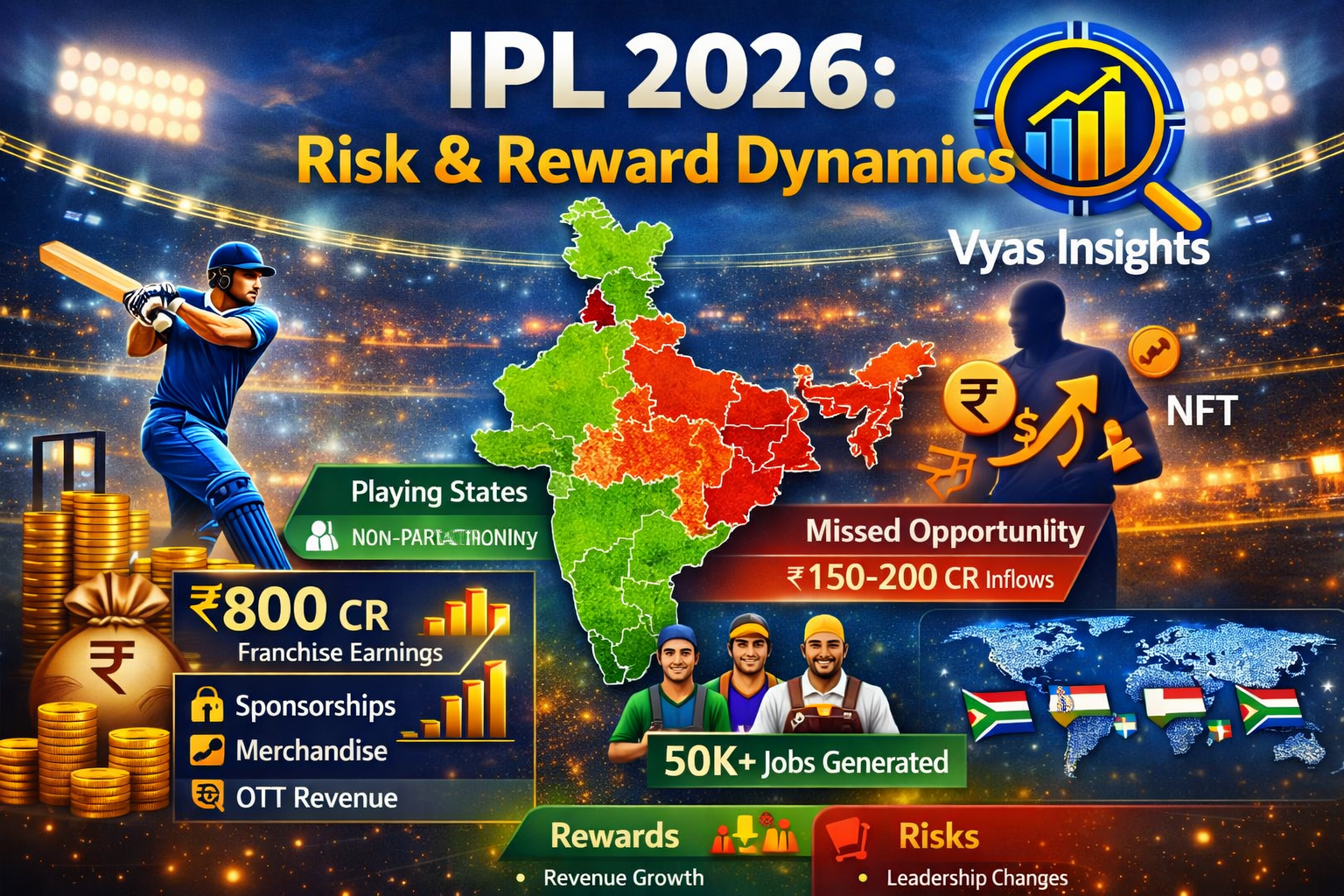
From captaincy shifts to franchise earnings, IPL 2026 is rewriting the risk‑reward playbook
⚖️ Leadership Transitions — The Risk‑Reward Equation
When MI and LSG captains stepped down, it wasn’t just a cricketing decision — it was a strategic reset. Leadership changes bring short‑term instability but open doors for renewal, fresh talent, and new branding opportunities.
👉 Conclusion:
The decision of MI & LSG captains stepping down is more than a cricketing headline. It’s a strategic gamble 🎲.
Risk: Short‑term instability, potential dip in fan loyalty.
Reward: Fresh leadership, brand renewal, and long‑term franchise resilience. Leadership shifts often trigger valuation swings 📉📈, but smart franchises convert uncertainty into opportunity.
💰 Franchisee Economics — Beyond Matchday Revenue
Franchises today are diversified enterprises. Sponsorships, merchandise, OTT content, and academies contribute nearly 30 % of annual earnings beyond matchday. Over‑reliance on star players is risky, but diversified portfolios ensure resilience.
👉Conclusion:
Each IPL team is a mini‑enterprise 🏢.
Revenue Streams: Sponsorships, digital rights, merchandise, OTT content.
Risk: Over‑dependence on star players 🌟.
Reward: Diversification through academies, global fan bases 🌍. Top franchises tentatively earn ₹600–800 crore annually, with nearly 30 % from non‑match activities.
👕 Player Strategies — ROI and Brand Leverage
Players are no longer just athletes — they are micro‑brands. Endorsements, NFTs, and performance bonuses extend their earning potential. Stepping down from captaincy may reduce immediate pay but can increase long‑term brand equity through mentorship and loyalty.
👉Conclusion:
As Players are micro‑brands 📱.
Contracts are only part of the story.
Endorsements, NFTs, and performance bonuses expand earnings.
Stepping down from captaincy may reduce immediate pay 💸 but can increase brand equity through mentorship and loyalty.
👷 Employment Generation — The Hidden Engine
IPL sustains 50,000+ jobs across logistics, hospitality, analytics, and media. Each matchday activates local economies — vendors, transport, and tourism.
👉Conclusion:
IPL sustains 50,000+ direct & indirect jobs 👨🔧👩🍳.
Ground staff, logistics, hospitality, digital analysts.
Each matchday activates local economies 🚖🍔📺. IPL is not just cricket — it’s a sports‑driven employment model.
🗺️ State Participation — Geography of Opportunity
Playing states earn ₹100–200 crore seasonal inflows from tourism, advertising, and stadium rentals. Non‑participating states miss out, widening the economic gap.
👉Conclusion:
IPL participation is not just prestige — it’s an economic opportunity that can uplift entire regions.
Playing states: Earn from stadium rentals, tourism, advertising 💵.
Non‑playing states: Miss out on ₹100–200 crore seasonal inflows ❌. This gap highlights sports geography inequality — urging policymakers to expand franchise footprints.
🌐 The Global Lens — IPL as Soft Power
IPL’s franchise model inspires leagues in South Africa, UAE, and the Caribbean. India exports not just cricket but a sports‑economy blueprint combining entertainment, analytics, and employment.
👉Conclusion: IPL is India’s soft‑power export, positioning the nation as a global innovator in sports economics.
🧭 Final Deep Conclusion
IPL 2026 is more than a tournament — it is a microcosm of India’s economic and strategic evolution.
Leadership transitions show how risk can be reframed as renewal.
Franchise economics highlight diversification as survival.
Player strategies prove individuals are now global brands.
Employment generation demonstrates sports as a livelihood engine.
State participation gaps reveal how opportunity is unevenly distributed.
Global adoption cements IPL as India’s soft‑power export.
👉 Complete Insight: IPL is not just cricket — it is a living case study in risk management, economic diversification, and regional development. For professionals, policymakers, and fans worldwide, IPL 2026 teaches that sports can be both entertainment and economic strategy, shaping leadership, livelihoods, and India’s global influence.